// contents
The 6 Pillars for AI Success
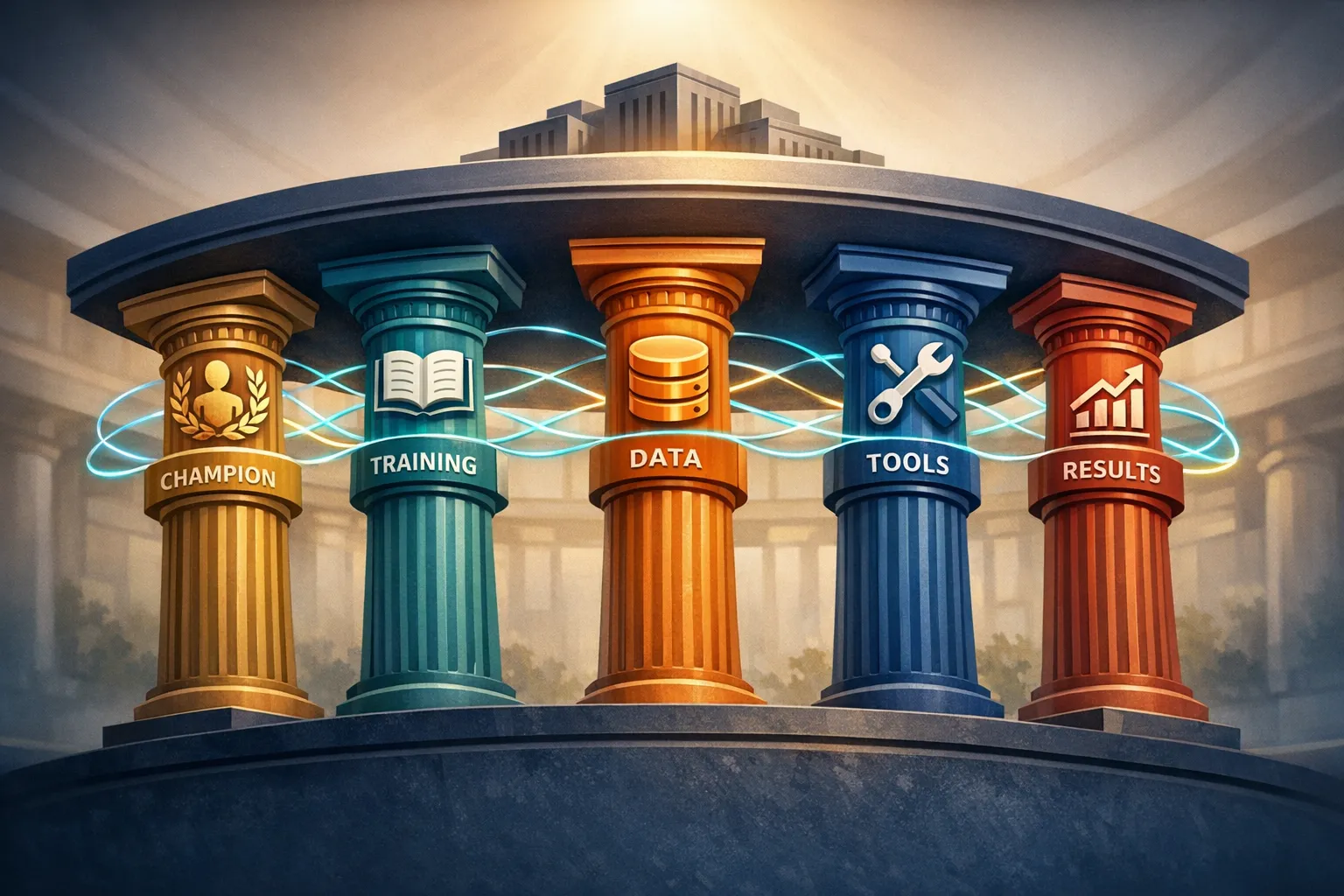
A practical framework for AI transformation built from real consulting experience. Champion, Training, Data, Tools, Operate, Results: all six pillars are vital for success.
// quick_hits
- >Most AI initiatives fail not because the technology doesn't work, but because the organization around it isn't set up for success.
- >All six pillars are vital. Skip one and the whole structure is unstable.
- >This framework comes from real consulting experience, not theory.
- >Results is the pillar most teams skip, which is exactly why they can't prove ROI or decide what to scale.
Why Most AI Initiatives Fail
The technology works. That's no longer the question. LLMs can reason, write code, analyze data, and handle complex workflows. The models have crossed the usefulness threshold. And yet most AI initiatives inside organizations still fail.
They fail quietly. A pilot that never scales. A tool that gets built but not adopted. A chatbot that gets launched, used for a week, then forgotten. An executive who announces an "AI strategy" that never produces measurable results.
After working with multiple companies on AI transformation, I've seen the same failure patterns repeat. The technology is rarely the problem. The organization around the technology is almost always the problem.
That experience led me to develop a framework I call the 6 Pillars of AI Transformation. It's not theoretical. It comes from watching what actually works and what doesn't when companies try to make AI a real part of how they operate.
The core insight is simple: all six pillars are vital for success. Skip one and the whole structure becomes unstable. It doesn't matter how strong the other five are.
The 6 Pillars Framework
The six pillars are:
- Champion - A named owner who sets priorities, removes blockers, and makes decisions
- Training - Practical, role-based training so people can use AI in their real workflows
- Data - Connect the right systems and give AI safe access to the right information
- Tools - Build and ship integrated workflows that actually do the work in production
- Operate - Keep it running with support, SLAs, monitoring, security, updates, and ongoing enablement
- Results - Measure impact and quality, prove ROI, and decide what to scale, fix, or kill
Each pillar addresses a different failure mode. Together, they cover the full lifecycle of AI inside an organization, from strategic direction to measurable outcomes.
Pillar 1: Champion
A named owner who sets priorities, removes blockers, and makes decisions.
Every successful AI initiative I've seen has one thing in common: a specific person who owns it. Not a committee. Not a "center of excellence." A named human being who wakes up every day thinking about how to make AI work inside their organization.
Why This Pillar Exists
AI transformation is inherently cross-functional. It touches engineering, operations, legal, HR, sales, marketing, and every other department. Without a single owner who can cut across those boundaries, initiatives die in the gaps between teams.
The champion doesn't need to be technical. They need to be empowered. They need the authority to set priorities ("we're doing this first"), remove blockers ("I'll handle the security review"), and make decisions ("we're going with this approach, let's move").
What Happens Without It
Without a champion, AI becomes everyone's side project and nobody's priority. Decisions stall because nobody has clear authority. Competing initiatives duplicate effort. When problems arise, and they always arise, there's nobody to push through them.
I've watched organizations spend six figures on AI tools that sit unused because nobody owned the rollout. The technology worked fine. Nobody was in charge of making sure people actually used it.
What Good Looks Like
The champion has a clear mandate from leadership, a budget, and the authority to make decisions without running everything up the chain. They maintain a prioritized backlog of AI initiatives, they have regular access to the teams doing the work, and they're accountable for outcomes, not just activity.
Pillar 2: Training
Practical, role-based training so people can use AI in their real workflows.
Most AI training is useless. It's a one-hour webinar where someone shows ChatGPT writing a poem, followed by vague encouragement to "explore AI in your work." People leave the session impressed by the demo and completely unable to apply it to their jobs.
Why This Pillar Exists
AI tools are only valuable when people actually use them, and use them well. That requires training that's specific to what each person does. A salesperson needs to learn how to use AI for prospect research and email drafting, not how transformers work. An engineer needs to learn how to use AI for code review and debugging, not how to write marketing copy.
What Happens Without It
Without proper training, one of two things happens. Either people don't use the tools at all (because they don't know how), or they use them poorly (because they don't understand the limitations). Both outcomes waste the investment in AI tooling.
Worse, bad early experiences create lasting resistance. If someone tries AI once, gets a hallucinated answer, and loses trust, you've potentially lost that person for months. Proper training sets expectations correctly and teaches people how to verify outputs.
What Good Looks Like
Training is role-based and task-specific. Instead of generic "intro to AI" sessions, you train the sales team on the three specific ways AI integrates into their CRM workflow. You train the support team on how to use AI to draft responses and find knowledge base articles. You train developers on AI-assisted code review within their actual IDE.
Training is also ongoing, not one-time. The tools change. The models improve. People's skills need to keep pace. Build training into the regular rhythm of the organization, not a one-off event.
Pillar 3: Data
Connect the right systems and give AI safe access to the right information.
AI is only as good as the information it can access. A brilliant model that can't see your customer data, your product specs, or your internal documentation is a brilliant model that can't help with your actual work.
Why This Pillar Exists
The default state of most organizations is data silos. Customer data lives in the CRM. Product data lives in the engineering wiki. Financial data lives in spreadsheets. Process documentation lives in someone's head.
AI can't bridge these silos on its own. You need to deliberately connect the right systems and give AI safe, structured access to the information it needs to be useful.
What Happens Without It
Without data connectivity, AI gives generic answers based on its training data instead of specific answers based on your business reality. People quickly learn that the AI "doesn't know anything about us" and stop using it.
Or worse, people start copying sensitive data into AI prompts manually, creating security and compliance risks that nobody is tracking.
What Good Looks Like
You've identified the 5-10 data sources that matter most for your highest-value AI use cases. You've connected them through APIs, RAG pipelines, or structured context injection. You've established clear data governance: what can AI access, what it can't, how access is audited, and how sensitive data is handled.
The data doesn't need to be perfect. It needs to be accessible, reasonably current, and clearly scoped. Start with the most impactful data sources and expand over time.
Pillar 4: Tools
Build and ship integrated workflows that actually do the work in production.
Having AI capability available is not the same as having AI doing useful work. The gap between "we have access to an LLM" and "AI is integrated into our production workflows" is enormous, and it's where most organizations stall.
Why This Pillar Exists
People don't want to use AI. They want their work to get done. The distinction matters. If using AI requires switching to a separate tool, copying context back and forth, and manually integrating the output into their existing workflow, most people won't bother. The friction is too high.
The tools pillar is about building AI into the workflows people already use, so the AI does work rather than creating extra work.
What Happens Without It
Without integrated tools, AI remains a novelty. People might use ChatGPT for occasional questions, but it never becomes part of how work actually gets done. The ROI stays theoretical because the AI is never in the critical path of value creation.
What Good Looks Like
AI is embedded in the tools people already use. The support platform auto-drafts responses using customer history. The code review tool flags issues and suggests fixes. The reporting system generates narrative summaries alongside the data. The sales CRM surfaces AI-generated insights at the moment they're relevant.
The key word is "integrated." The best AI tools are invisible. People don't think "I'm using AI now." They think "this tool is really good."
Pillar 5: Operate
Keep it running with support, SLAs, monitoring, security, updates, and ongoing enablement.
Launching an AI tool is the beginning, not the end. AI systems require ongoing operational support that most organizations underestimate. Models change. APIs deprecate. Performance degrades. Security requirements evolve. Users hit edge cases.
Why This Pillar Exists
AI systems are not "set and forget." Unlike traditional software that behaves the same way every time, AI systems can produce different outputs for the same inputs, their behavior changes when underlying models are updated, and their failure modes are often subtle rather than obvious.
This means you need operational practices specifically designed for AI: monitoring that catches quality degradation, not just uptime; security reviews that account for prompt injection and data leakage; update processes that test new model versions before they hit production.
What Happens Without It
Without operations, AI systems decay. The model provider ships an update that subtly changes behavior, and nobody notices until customers complain. A prompt injection vulnerability goes unpatched because nobody is monitoring for it. The AI tool breaks because an upstream API changed, and there's no support process to fix it.
I've seen organizations launch impressive AI features that silently degraded over months because nobody was watching. By the time anyone noticed, users had already lost trust.
What Good Looks Like
You have defined SLAs for your AI systems, just like any other production service. You monitor output quality, not just availability. You have a process for testing and rolling out model updates. Security reviews happen regularly. There's a support channel where users can report issues with AI-generated outputs.
Ongoing enablement is part of this pillar too. As the tools evolve and improve, you proactively train users on new capabilities rather than hoping they discover them on their own.
Pillar 6: Results
Measure impact and quality, prove ROI, and decide what to scale, fix, or kill.
This is the pillar most organizations skip, and it's exactly why they can't answer the question every executive eventually asks: "Is our AI investment actually working?"
Why This Pillar Exists
Without measurement, you're flying blind. You don't know which AI initiatives are delivering value and which are wasting resources. You can't make informed decisions about what to scale, what to improve, and what to shut down. You can't justify continued investment because you have no evidence of returns.
What Happens Without It
Without results measurement, AI initiatives exist in a permanent state of ambiguity. Supporters claim success based on anecdotes. Skeptics claim failure based on different anecdotes. Nobody has data. Budget conversations become political rather than analytical.
Eventually, leadership either cuts AI funding because they can't see the return, or they keep funding it out of fear of falling behind, but with growing resentment and declining organizational support. Neither outcome is good.
What Good Looks Like
Every AI initiative has defined success metrics before it launches. These metrics are specific, measurable, and tied to business outcomes, not just technical metrics. "Reduced average support response time by 40%" is a good metric. "Processed 10,000 queries" is not.
You review these metrics regularly and make hard decisions based on what they tell you. Some initiatives will succeed and should be scaled. Some will underperform and need adjustment. Some will fail and should be killed. The data tells you which is which.
The results pillar also includes quality measurement. AI outputs need ongoing quality assessment because, unlike traditional software, the same system can produce varying quality over time. Build quality checks into the workflow and track quality trends.
All Pillars Are Vital
I want to be direct about this because it's the most important thing I've learned from this work: you cannot skip a pillar.
I've watched organizations with brilliant technical teams (strong Tools) fail because nobody owned the initiative (no Champion). I've seen companies with perfect data infrastructure (strong Data) fail because people couldn't use the tools (no Training). I've seen impressive launches (strong Tools, great Champion) decay because nobody monitored quality (no Operate) or measured impact (no Results).
The pillars are interdependent:
- Tools without Training means nobody uses what you built
- Training without Data means people learn skills they can't apply to real work
- Data without Tools means information sits in a pipeline nobody interacts with
- Everything without a Champion means nobody resolves the inevitable conflicts and blockers
- Everything without Operate means things break and trust erodes
- Everything without Results means you can't prove value or make informed decisions
Where to Start
If you're early in your AI journey, start with Champion. Name an owner. Give them authority and accountability. Then work on Data and Training in parallel: connect your information systems and teach people how to work with AI.
With those three foundations in place, you can build Tools with confidence that people will use them and that the AI will have the context it needs. Then build Operate and Results practices around what you ship.
The Framework in Practice
This framework isn't about doing all six things perfectly from day one. It's about making sure you're not ignoring any of them. Even a minimal version of each pillar is better than having five strong pillars and one completely absent.
Ask yourself: Do we have a named champion? Are people trained on their specific use cases? Does AI have access to the data it needs? Are we building integrated tools, not just playing with chat? Are we operating and monitoring what we ship? Are we measuring results and making decisions based on data?
If the answer to any of those questions is no, you've found your weakest pillar. Strengthen it before doubling down on the others. The chain really is only as strong as its weakest link.
// references
- —Based on direct consulting experience across multiple enterprise AI implementations
// faq
What are the 6 pillars for AI success?
Champion, Training, Data, Tools, Operate, and Results. Each pillar addresses a critical dimension of AI transformation: leadership, enablement, information access, production workflows, ongoing operations, and measurable impact.
Do I need all six pillars?
Yes. All pillars are vital for success. Organizations that skip even one pillar consistently struggle. The pillars are interdependent: great tools without training go unused, training without data access is theoretical, and none of it matters without measurement.
Where should I start?
Start with Champion. Without a named owner who has authority and accountability, the other pillars lack direction. Then move to Data and Training in parallel, followed by Tools, Operate, and Results.
Is this framework only for large enterprises?
No. The pillars scale down to small teams and startups. A 5-person company still needs someone championing AI, practical training, connected data, real tools, operational support, and measurement. The scope changes, but the structure doesn't.
// key_takeaway
AI transformation requires six pillars working together: Champion, Training, Data, Tools, Operate, and Results. This framework comes from real consulting experience, and the consistent lesson is that all six are vital. Skip one and the initiative stalls.